

As artificial intelligence tools such as Midjourney and Stable Diffusion revolutionize creative industries, Chinese courts are being asked a fundamental question: When is AI-generated content worthy of copyright protection?
Two recent court decisions—one from the Suzhou Intermediate People’s Court and the other from the Beijing Internet Court—appear to offer opposite answers. But a closer look reveals a deeper, evolving legal framework in China’s response to AI-generated works.
Case 1: Suzhou Says No – The AI is Not the Author
In the 2024 case Feng v. Dongshan Company, the plaintiff, Feng, sued a furniture manufacturer for allegedly copying a series of AI-generated design images he created using Midjourney. The images, shared on the Xiaohongshu platform, were part of an art project called Phantom Wings Transparent Art Chair. Feng accused Dongshan of reproducing similar works with AI tools and commercializing them without permission.
However, both the Zhangjiagang City People’s Court ruled against Feng. The decision was appealed but currently confirmed effective by Suzhou City Intermediate People’s Court. The court emphasized that for contents majorly generated by AI, a court shall not consider it a copyrighted work. Below several indications / implications:
Originality must stem from human intellectual effort. Feng failed to demonstrate sufficient personal input or creative control in the generation of the images.
The use of prompts was treated as an "idea" rather than a "creative expression" under copyright law, meaning it cannot be protected.
The randomness and opacity of tools like Midjourney made it difficult to assess authorship or the replicability of the work.
The court concluded that AI-generated content, without demonstrable human authorship or intervention, does not qualify as a copyrightable work. This case marked a cautious stance, stressing the need to prevent misclassification of machine output as protected intellectual property.
Case 2: Beijing Says Yes – Human-AI Collaboration Recognized
Contrast this with a 2023 decision by the Beijing Internet Court, where the plaintiff claimed rights over an image generated using Stable Diffusion, another popular AI tool. In that case:
The plaintiff submitted detailed records showing how the image was generated, including prompt engineering, multiple iterations, and manual post-processing.
The court accepted that this level of human direction and editing demonstrated sufficient originality and intellectual labor to merit copyright protection.
The defendant, who had directly copied and reused the image, was found liable for infringement.
This decision showed a more flexible and inclusive view of creativity in the AI era, treating the tool as analogous to a paintbrush or camera—valuable, but not autonomous.
How Can Two Courts Reach Different Conclusions?
At first glance, the Suzhou and Beijing cases seem contradictory. But both rulings actually reflect a shared legal principle: only works with clear human intellectual contribution can be protected under China’s copyright law.
As we can see from the table below, the divergence comes from the level of evidence presented:
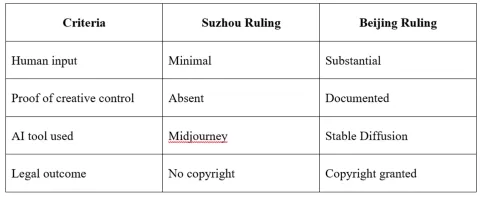
The Suzhou court adopted a stricter evidentiary threshold, likely responding to the increasing volume of automated content. Meanwhile, the Beijing ruling suggests that with proper documentation, AI-assisted works can still fall under the protection of traditional copyright frameworks.
Implications for Creators and the AI Generated Creativity Industry
These rulings signal that China is not rejecting AI-generated creativity, but rather insisting on accountability and clarity. For creators, brands, and businesses, several lessons emerge:
Document the creative process: Save prompt iterations, screenshots, editing logs, and concept sketches.
Treat AI as a tool, not a co-author: Emphasize your role in directing and shaping the final output.
Be ready to prove authorship: Courts will expect evidence of intellectual input beyond mere prompt entry.
For AI developers and platforms, these rulings also imply the growing need for transparency and traceability in how content is generated—something that may become a standard legal requirement.
Conclusion: A Framework in Progress
China’s courts are navigating uncharted territory as AI technology rapidly changes how content is created. These two cases illustrate a maturing legal landscape, not inconsistency. The guiding thread remains clear: Human creativity must remain at the core of intellectual property rights.
As the law continues to evolve, the challenge for courts, creators, and companies alike will be to balance technological innovation with the legal foundations of authorship, originality, and protection.