

By Skye Zou
In a recent retrial decision, the Supreme People’s Court of China (SPC) revisited the standards for assessing trademark use in three-year non-use cancellation proceedings, overturning both first- and second-instance administrative judgments.
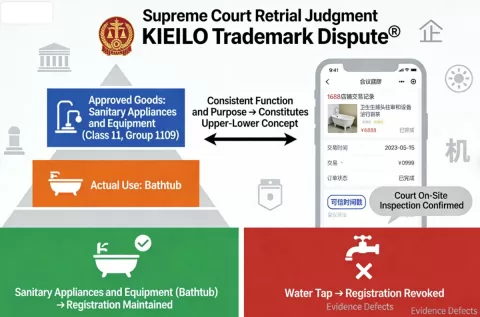
The ruling provides timely guidance on two issues of continuing importance for trademark owners: whether use on goods falling within a subordinate category can sustain a broader registration, and how online platform transaction records should be evaluated as evidence of genuine commercial use.
Purpose-Oriented Interpretation of Trademark Use
The SPC reaffirmed that the three-year non-use cancellation mechanism under the Chinese Trademark Law serves a functional, rather than punitive, purpose. Its objective is to promote active use of trademarks and prevent the warehousing of registration resources, while preserving marks that continue to perform their essential function of identifying the source of goods in the marketplace.
Accordingly, the assessment of trademark use should not be reduced to a formalistic exercise, but should focus on whether the registrant demonstrates a genuine intention to use the mark and whether the relevant conduct enables the public to establish a stable association between the trademark and the goods.
This approach reflects the SPC’s broader tendency to align trademark adjudication with commercial realities.
Use on Subordinate Goods Within the Approved Scope
A key issue before the Court was whether use of the disputed trademark on bathtubs could qualify as use on the designated goods “sanitary apparatus and installations” in Class 11. Although “bathtubs” are not expressly listed as a standard item in China’s Classification of Similar Goods and Services, the SPC rejected a purely literal interpretation of the registration scope.
The Court emphasized that classification tables are administrative reference tools rather than rigid legal boundaries. From a functional perspective, bathtubs constitute bathing equipment whose purpose and use are consistent with sanitary apparatus and installations. On this basis, the SPC held that bathtubs fall within a subordinate category of the approved goods and that trademark use on such products should, in principle, be recognized as compliant with the registration.
This reasoning is particularly relevant for foreign brand owners operating in China, as product nomenclature used in international markets does not always align neatly with standardized Chinese classification terminology.
The judgment confirms that courts may adopt a substantive, function-based analysis rather than a narrow textual comparison.
Evidentiary Value of E-Commerce Platform Records
The SPC also addressed the evidentiary standards applicable to online sales. In this case, the trademark owner submitted backend transaction records from its 1688 (Alibaba) store, confirmed by a trusted timestamp and verified through in-court inspection. The records demonstrated completed transactions during the relevant three-year period, with product images clearly displaying the disputed trademark.
The Court accepted this evidence as forming a complete and credible chain of proof, sufficient to establish genuine, public-facing commercial use. In doing so, the SPC implicitly acknowledged the central role of e-commerce in contemporary Chinese commerce and confirmed that properly authenticated platform data can carry substantial probative value in non-use cancellation disputes.
Differentiated Treatment of Multiple Designated Goods
While the SPC upheld the registration for sanitary apparatus and installations, it reached a different conclusion regarding the designated goods “water taps.” The evidence submitted in this respect was found insufficient, as it failed to clearly demonstrate that the trademark was actually used on water taps sold during the relevant period. Sales records showing products capable of being fitted with taps, or lacking clear trademark identification, were deemed inadequate.
As a result, the SPC confirmed the partial cancellation of the trademark for water taps, underscoring that flexibility in assessing use does not eliminate the requirement that evidence must be specific, direct, and clearly linked to each designated good.
Practical Implications
This decision reinforces a balanced judicial approach to trademark use in China.
On the one hand, the SPC demonstrates a willingness to recognize use on subordinate or functionally equivalent goods and to accept modern forms of evidence reflecting digital commerce.
On the other hand, it maintains a disciplined evidentiary threshold, particularly where a trademark is registered for multiple categories of goods.
For international brand owners, the ruling highlights the importance of evidence planning that reflects actual market practices in China, as well as careful alignment between product branding, sales documentation, and the scope of registered goods. It also suggests that China’s highest court is increasingly attentive to commercial substance, rather than formal labels, when evaluating trademark use.