

by Joy Dong
In today’s highly competitive consumer market, packaging is no longer merely “packaging.” It carries brand recognition, shelf presentation, and consumer memory, often all at once.
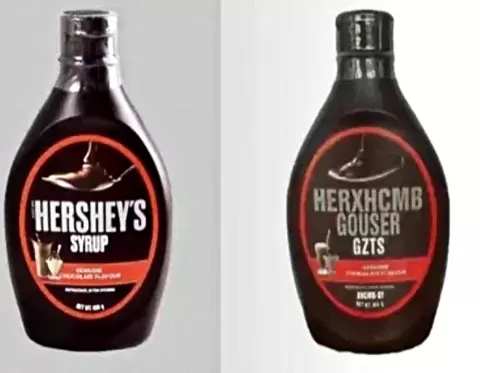
A recent dispute involving Hershey’s chocolate syrup products vividly illustrates how Chinese courts approach packaging protection under the framework of the Anti-Unfair Competition Law (AUCL), and the evidentiary burden brand owners must meet.
Packaging Protection vs. Trademark Protection: Two Distinct Legal Routes
Under China’s legal system, registered trademarks are primarily protected by the Trademark Law. Unregistered commercial identifiers (including what is often referred to in common law jurisdictions as “trade dress”, i.e. product packaging and decoration) are governed by the Anti-Unfair Competition Law.
Under Article 7 of the AUCL, a claimant must prove two elements to obtain protection for packaging or decoration:
1. The packaging has “certain influence,” meaning it has achieved recognition among the relevant public in China;
2. The packaging possesses distinctive features capable of identifying the source of the goods.
Both elements are indispensable. Market reputation without distinctiveness, or distinctive design without market influence, is insufficient.
“Certain Influence”: Recognition
by the Relevant Public
within China
The court found that Hershey’s syrup products had been sold in China since at least 2016, with wide geographic coverage and relatively high recognition within relevant industry sectors. Sales data, advertising materials, and distribution channel evidence demonstrated continuous and stable use of the packaging.
Importantly, “certain influence” does not require nationwide fame. The standard is whether the packaging has achieved recognition among the relevant public in the relevant product field within continental China.
Foreign recognition alone is insufficient. The key question is whether the packaging has acquired commercial source-identifying significance in continental China. The assessment of “certain influence” is explicitly limited to continental China.
A Deeper Jurisprudential Shift: From Protecting “Well-Known Products” to Protecting “Well-Known Identifiers”
Notably, the 2017 revision of the AUCL replaced the phrase “unique packaging of well-known products” with “product packaging with certain influence.” This was not a lowering of the protection threshold. Rather, it corrected a misconception: the law protects commercial identifiers with source-identifying functions, not the “well-known product” as such.
Even if a product itself is famous, if its packaging changes frequently and fails to form a stable market image, such that consumers cannot rely on it to identify source, it will not qualify for protection.
This underscores that rights holders must provide evidence of the independent market influence and source-identifying function of the specific packaging configuration at issue.
Distinctiveness: Overall Impression Over Individual Elements
In assessing distinctiveness, the court adopted the principle of overall observation and comprehensive evaluation.
Courts do not dissect packaging into individual elements and assess each for commonality in isolation. Instead, they consider whether the combination of text, graphics, colors, shapes, size, positioning, and arrangement forms a distinctive overall image capable of enabling consumers to identify the source.
In this case, the court found that the coordinated graphic design, color scheme, element arrangement, and structural presentation formed a stable overall image. Through long-term use and promotion, this image had become specifically associated with Hershey’s syrup products in the minds of relevant consumers.
The judicial logic is clear: common industry elements cannot be monopolized individually. However, when combined in a particular way that forms a distinctive and stable commercial impression, the overall configuration may be protectable.
Inherent Distinctiveness
and Acquired Distinctiveness
In recent years, Chinese courts have increasingly drawn upon trademark law theory when analyzing packaging distinctiveness.
Some packaging may possess inherent distinctiveness: for example, highly original visual designs. More often, however, packaging lacks strong originality at the outset but acquires distinctiveness through continuous use and market promotion. This is often referred to as “acquired distinctiveness” or “secondary meaning.”
Once acquired distinctiveness is proven, it can typically satisfy both elements required under Article 7:
Long-term use establishes “market influence”;
Consumer association establishes “source-identifying function.”
Nevertheless, courts remain cautious. If packaging changes substantially and frequently, or if promotional evidence focuses primarily on the brand name rather than the packaging design itself, protection may be denied.
The protectable subject matter is the specific, stable visual configuration — not the abstract extension of product reputation.
Distinguishing Trademark Claims from Packaging Claims
In practice, brand owners may choose to:
Include trademark wording as part of the overall packaging claim; or
Exclude trademark wording and claim only the background layout and visual design.
If trademark wording is excluded, this does not mean simply covering up the trademark graphic. Rather, when evaluating overall distinctiveness, the court disregards the semantic meaning of the trademark text, while still considering its visual aspects, such as position, size, font, and color, as integral parts of the packaging layout.
This can be analogized to replacing the trademark wording with meaningless text of equal length, and then assessing the resulting visual configuration.
Courts always base their judgment on the consumer’s overall perception and do not artificially isolate elements.
This approach prevents strategic dissection while maintaining conceptual boundaries between trademark rights and packaging protection.
Practical Significance of the Case
International companies entering the Chinese market must consider that packaging and trade dress can be protected as independent commercial identifiers but only with sufficient evidence.
Unlike the trademark registration system, packaging protection under the AUCL is highly evidence-dependent. Rights holders must systematically preserve and demonstrate:
Continuous and stable use of the specific packaging in continental China;
Consistency in visual presentation;
Adequate market coverage and promotional investment;
Consumer association between the specific packaging and a particular source.
For Chinese enterprises, the case also serves as a warning: in imitation-based competition, replicating the overall commercial impression of a competitor’s packaging may constitute unfair competition, even if individual elements are commonly used within the industry.
In today’s visually driven consumer environment, packaging carries commercial value comparable to word trademarks. The boundary between inspiration and infringement may ultimately turn on the “overall impression.”
A Broader Judicial Trend
In recent years, Chinese courts have become increasingly sophisticated in handling packaging and trade dress cases. Their analytical framework has grown more structured, aligning progressively with international principles while maintaining domestic legal terminology.
The Hershey’s syrup case exemplifies this trend:
Packaging is not automatically protected. But when distinctiveness and market influence are proven, courts will provide clear support.
For brand owners, the lessons are concrete:
Register trademarks early.
Maintain consistency in visual design.
Systematically preserve evidence of market use.
Treat packaging as a strategic asset, not mere decoration.
Because in modern commerce, consumers often recognize a product through its distinctive packaging long before they read the brand name.