

by Fredrick Xie
What made this year’s Supreme People’s Court IP release interesting was not the report itself. It was the bundle.
On 20 April 2026, the Court did not just issue its annual report on judicial protection of intellectual property. It released, at the same time, the 2025 judicial protection report, the Implementation Plan for 2026–2030, the new judicial interpretation on punitive damages in IP civil cases, and the 2025 typical IP cases.
Around the same release cycle, it also published the Annual Report on Legal Application Issues in IP Cases, distilling 45 legal-application issues from cases concluded in 2025.
The headline figure is easy enough to repeat: in 2025, Chinese courts newly accepted 552,600 IP cases and concluded 539,649. But that number, on its own, is not really the point.
Chart 1. What the SPC Chose to Highlight in 2025
Highlighted category | Figure | Note |
Concluded first-instance civil technology-related IP cases | 64,000 |
|
Concluded disputes involving data ownership and transactions | 908 | +25.6% YoY |
Concluded first-instance trademark civil infringement cases | 115,300 |
|
Concluded first-instance trademark criminal cases | 8,033 |
|
Concluded first-instance copyright civil cases | 256,400 |
|
Concluded first-instance unfair competition civil cases | 10,135 |
|
Cases in which monopolistic conduct was found | 27 |
|
Newly accepted first-instance foreign-related IP cases | 11,066 | +34.1% YoY |
That shift becomes clearer once the last few years are placed side by side. China’s IP docket remains enormous, but the more interesting development is structural. The overall volume has fluctuated rather than moving in a straight line, while the composition of the docket has been moving in a more definite direction.
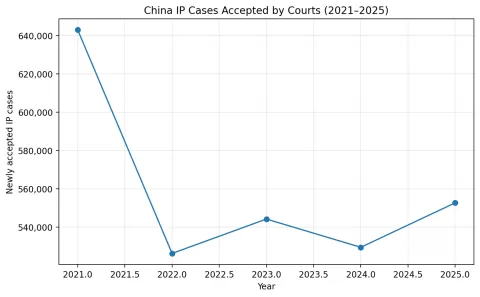
Chart 2. China IP Cases Accepted by Courts (2021–2025).
The story is not steady year-on-year growth, but a consistently high-volume system with fluctuation.
One technical point should be noted: the 2021–2024 reports mainly present newly accepted case figures by category, whereas the 2025 release foregrounds a set of selected concluded-category figures. Not every figure is therefore directly comparable across all five years.
That becomes even more obvious once one looks inside the case mix. If one wants to understand where Chinese IP adjudication is actually moving, the better indicators are no longer the totals alone.
The more revealing categories are patents, technology contracts, competition disputes, data, and trade-secret style cases.
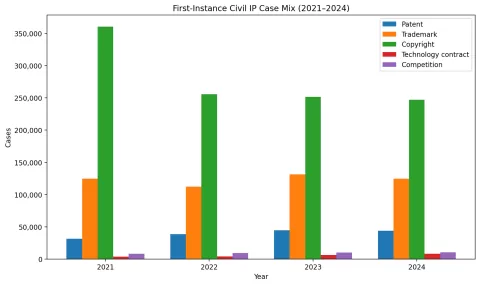
Chart 3. First-Instance Civil IP Case Mix (2021–2024).
Copyright and trademark still dominate by volume, but the real movement has been toward patent, technology contract, and competition litigation.
That structural shift is exactly why the Implementation Plan (2026–2030) deserves to be read together with the annual report. The report tells us what the Court handled. The plan tells us what the Court wants to push: integrated circuits, industrial mother machines, high-end instruments, basic software, advanced materials, bio-manufacturing, aerospace, new energy, data rights, artificial intelligence, anti-monopoly, unfair competition, trade secrets, and foreign-related disputes.
The plan also leans into procedure and enforcement tools: conduct preservation, evidence preservation, prior judgments, better coordination between civil, administrative and criminal mechanisms, closer linkage between judicial and administrative protection, and eventually a more specialized litigation framework. It reads like a roadmap for a more technical, more policy-aware, and more assertive IP judiciary.
The same is true of remedies. Punitive damages have been growing in importance for several years, but this year the Court chose to underline that trend by issuing a separate judicial interpretation on punitive damages at the same time as the annual report. It shows that punitive damages are no longer being treated as a decorative feature reserved for a few headline cases. They are being folded into the mainstream architecture of serious IP enforcement.
Then there is the Annual Report on Legal Application Issues in IP Cases. This document serves a different function from the annual judicial-protection report.
For IP lawyers, that has obvious consequences. These materials are not just useful for client alerts or year-end summaries. They are also a map of what the Court currently cares about. Cases involving high-value technology, data disputes, trade secrets, anti-monopoly, unfair competition, foreign-related litigation, and serious bad-faith conduct are less and less likely to be treated as ordinary private disputes.
More and more often, they will be heard against a broader background of industrial policy, market-order concerns, and remedial escalation.
That means case framing matters more than before. A dispute is no longer only about whether infringement occurred. More and more often, it is also about whether the case can be presented as involving strategic innovation, digital governance, market-order distortion, or deliberate and serious misconduct deserving stronger remedies.
Source note
Prepared based on the Supreme People’s Court’s 2025 judicial protection report and accompanying materials released on 20 April 2026, read together with the Court’s annual reports for 2021–2024.