

By Hansen Tao
Like every year before and during the Mid-Autumn Festival, shelves across China are lined with elaborately designed mooncake boxes, some so ornate that the packaging itself has become a symbol of gift-giving culture. Yet, behind the festive charm, a growing number of packaging disputes reveal the legal complexities surrounding “trade dress” protection under Chinese unfair competition law.
A recent decision by the Guangzhou Intellectual Property Court illustrates how Chinese courts are refining the boundaries of protection for product packaging with “certain market influence” (有一定影响的商品装潢), a concept increasingly vital to brand owners in highly visual consumer markets.
The Case: “Seven Stars Accompanying the Moon”
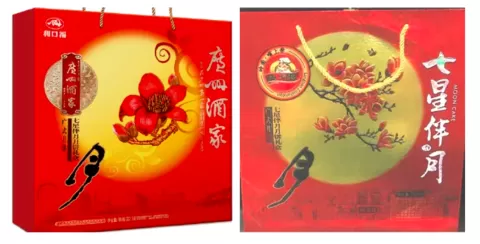
The dispute centered on Guangzhou Restaurant Group (广州酒家), a well-known time-honored brand established in 1935, and its signature mooncake gift box known as “Seven Stars Accompanying the Moon” (七星伴月). Since its introduction in 2009, the packaging has become instantly recognizable to Chinese consumers: a vivid red background, a golden full moon, and elegant floral imagery, design elements that combine traditional aesthetics with brand identity.
In 2022, a competing product marketed as “Master X’s Seven Stars Accompanying the Moon” appeared in local supermarkets, featuring a strikingly similar visual composition. Guangzhou Restaurant alleged that the rival packaging closely mimicked the distinctive features of its own and was likely to mislead consumers into believing the products were associated. The company sued the producer and two subcontractors for unfair competition.
Judicial Reasoning: Broader Comparison for Famous Packaging
At first instance, the Yuexiu District Court found that Guangzhou Restaurant’s packaging had acquired “certain market influence” through long-term promotion and consumer recognition. Although individual design elements such as red backgrounds or moon motifs belong to the public domain, the overall combination and visual effect were distinctive enough to serve as an indicator of commercial origin.
The trial court held that the defendant’s packaging was similar enough to cause confusion and ordered compensation of RMB 150,000. Both parties appealed.
On appeal, the Guangzhou IP Court upheld the finding of unfair competition but raised the damages to RMB 500,000, recognizing the significant goodwill and investment associated with the “Seven Stars Accompanying the Moon” design.
Importantly, the appellate court clarified the standard for comparing packaging similarity. Citing Article 12 of the Supreme People’s Court’s Judicial Interpretation on the Anti-Unfair Competition Law, the judges noted that the assessment should follow principles used in trademark similarity analysis, particularly the perspective of the average consumer and the distinctiveness and reputation of the earlier design.
The court further emphasized that when a product’s packaging enjoys high public recognition, a broader comparison standard should apply. Minor differences, such as variations in floral motifs or wording, are insufficient to eliminate the likelihood of confusion if the overall visual impression remains substantially similar.
Key Takeaways: Expanding the Scope of Trade Dress Protection
This decision underscores several trends in Chinese unfair competition adjudication:
1. Recognition of “Trade Dress” as Market Identity
Courts continue to affirm that packaging can function as a commercial identifier, independent of trademark registration, provided it has acquired market distinctiveness through consistent use and promotion.
2. Holistic Comparison and Broader Protection for Famous Designs
The Guangzhou IP Court’s application of a “wider comparison standard” reflects judicial sensitivity to the cumulative effect of packaging design. For brands with strong market presence, competitors cannot rely on minor alterations to escape liability.
3. Enhanced Damages Reflecting Brand Value
Raising the compensation from RMB 150,000 to RMB 500,000 signals a growing judicial willingness to assign real commercial weight to packaging reputation, especially for heritage brands.
4. Public Interest and Market Order Considerations
The judgment reinforces that protecting distinctive packaging is not only about safeguarding private business interests but also about maintaining fair competition and preventing consumer deception in the marketplace.
Implications for Businesses
For brand owners in China, especially in fast-moving consumer goods, cosmetics, and food sectors, this case serves as a reminder that consistent branding and packaging design can build enforceable rights even without formal registration as a trademark.
Conversely, companies developing new packaging should conduct visual clearance checks to avoid trade dress conflicts, particularly when referencing traditional motifs that may already be strongly associated with established brands.
As consumer markets in China grow more design-driven, the boundaries between creativity and imitation are increasingly scrutinized under the Anti-Unfair Competition Law. The Guangzhou IP Court’s ruling signals that distinctive visual identity, much like a trademark, is a valuable asset worthy of robust protection.