

By Skye Zou
Introduction
Film, television, and broader creative industries continue to expand in China, and consequently legal disputes at the intersection of trademark protection and audiovisual production are increasing. One recurring question concerns whether altering or removing trademarks from real products used as film or television props can amount to trademark infringement: this practice is known as reverse passing off.
Reverse passing off is a less commonly discussed but equally impactful form of unfair competition.
Instead of falsely suggesting that one’s own goods come from another source, as in traditional passing off, reverse passing off involves presenting someone else’s goods or services as one’s own. This can occur through actions such as removing or modifying the original branding, repackaging the product, or simply failing to acknowledge the true producer.
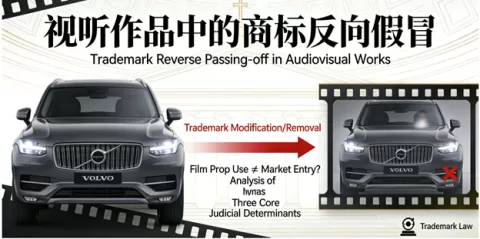
A recent case decided by Beijing courts provides important guidance on this issue. In rejecting a trademark infringement claim involving branded vehicles used in a commercial film, Chinese courts reaffirmed a core principle of trademark law: reverse passing off requires that the altered goods be placed back into the stream of commerce. The mere appearance of modified products as film props, without market re-entry, does not satisfy this requirement.
The decision offers valuable clarification for trademark owners, film producers, and international brands operating in China.
Reverse Passing Off Under Chinese Trademark Law
China formally incorporated the concept of reverse passing off into its Trademark Law in 2001. Under the current legal framework, Article 57(5) defines infringement as the unauthorized removal or replacement of another party’s registered trademark, followed by the act of putting the altered goods back into the market.
Judicial practice has consistently interpreted this provision as requiring the cumulative satisfaction of three elements.
First, the goods must originate from the trademark owner or an authorized source.
Second, the registered trademark must be removed, concealed, or replaced without permission.
Third, and most critically, the altered goods must be reintroduced into the marketplace.
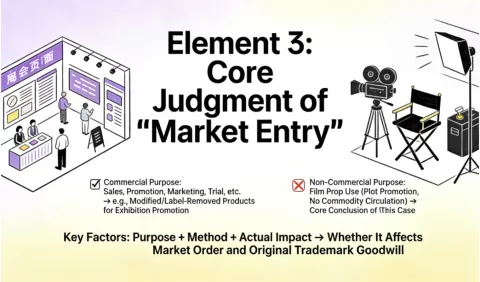
If any one of these elements is absent, a claim for reverse passing off cannot succeed.
The Film Prop Dispute
In the case at issue, the trademark owner and its authorized licensee discovered that their branded vehicles appeared repeatedly in a commercial film. Some of the vehicles had their trademarks and model identifiers removed or altered, while other vehicles in the same scenes retained visible branding.
The plaintiffs argued that the removal of the trademarks severed the link between the goods and their commercial source, weakened trademark distinctiveness, and therefore constituted reverse passing off.
Based on these arguments, the plaintiffs sought to characterize the film’s use of the vehicles as an unauthorized commercial exploitation of their trademarks.
Why the Courts Rejected the Claim
Both the Beijing Chaoyang District People’s Court and the Beijing Intellectual Property Court rejected the infringement claim. Their reasoning focused squarely on the absence of market re-entry.
The courts emphasized that a film does not function as a marketplace. Products used as props serve narrative and artistic purposes rather than commercial ones, and audiences do not encounter such goods as items offered for sale.
Watching a film does not place the goods back into circulation, nor does it transfer them from the production environment to consumers as commodities.
Because the vehicles were not resold, advertised as goods, or otherwise commercialized after the alleged trademark alteration, the courts held that the essential element of “putting the goods back into the market” was not satisfied.
The courts further noted that the function of trademarks in a cinematic context differs fundamentally from their role in ordinary commercial transactions.
In the marketplace, trademarks identify source, signal quality, and accumulate goodwill. In films, however, audiences focus on narrative, characters, and visual storytelling. Props do not operate as purchasing signals, and trademark visibility (or invisibility) does not perform its usual economic function.
As a result, altering trademarks on film props does not necessarily interfere with the interests that trademark law is designed to protect.
Market Re-Entry as the Decisive Threshold
While the origin of the goods is often undisputed in film-related cases involving genuine products, and while courts interpret “replacement” of trademarks broadly, these elements alone are insufficient. Chinese courts consistently treat market re-entry as the decisive threshold.
In assessing whether goods have been put back into the market, courts examine the purpose of the use, the manner in which the goods are presented, and the realistic impact on consumer purchasing decisions. Artistic or narrative use typically falls outside the scope of trademark infringement, whereas commercial promotion or disguised advertising may cross the line.
In this case, the use of the vehicles remained firmly within the realm of cinematic expression rather than commercial exploitation.
Implications for Rights Holders and Creators
For trademark owners, the case serves as a reminder that trademark rights, while robust, are not unlimited. Enforcement strategies must account for commercial context and actual market effects, rather than focusing solely on technical alterations of marks. Overly aggressive enforcement risks being perceived as an abuse of rights, potentially undermining both legal credibility and business relationships.
For film and media producers, the ruling provides welcome clarity. The use of branded goods as props generally carries low trademark infringement risk, provided the goods are not reintroduced into commerce or used to mislead audiences about sponsorship, endorsement, or product promotion.
The risk profile changes, however, if a film effectively functions as advertising or if branding alterations create false commercial associations.
Balancing Trademark Protection and Creative Freedom
More broadly, the decision reflects a maturing judicial approach in China that seeks to balance the protection of legitimate trademark interests with the need to preserve creative freedom. By anchoring liability to market re-entry, courts prevent trademark law from becoming a tool of excessive control while ensuring that core commercial interests remain protected.
This balance is particularly important as China’s cultural and creative industries continue to grow alongside its increasingly sophisticated intellectual property system.
Conclusion
The Beijing courts’ rulings make clear that reverse passing off under Chinese trademark law is not triggered by trademark alteration alone. Without the reintroduction of altered goods into the market, infringement cannot be established.
For international brands, the case highlights the importance of understanding how Chinese courts assess the real-world commercial impact of alleged infringement.
For filmmakers and content creators, it offers practical reassurance regarding the lawful use of branded props.