
By Seven Liu
A 2023 case before the Shanghai courts illustrates how far protection for a well-known trademark can extend when another business uses similar signs, branding and advertising to create an association with a famous company.
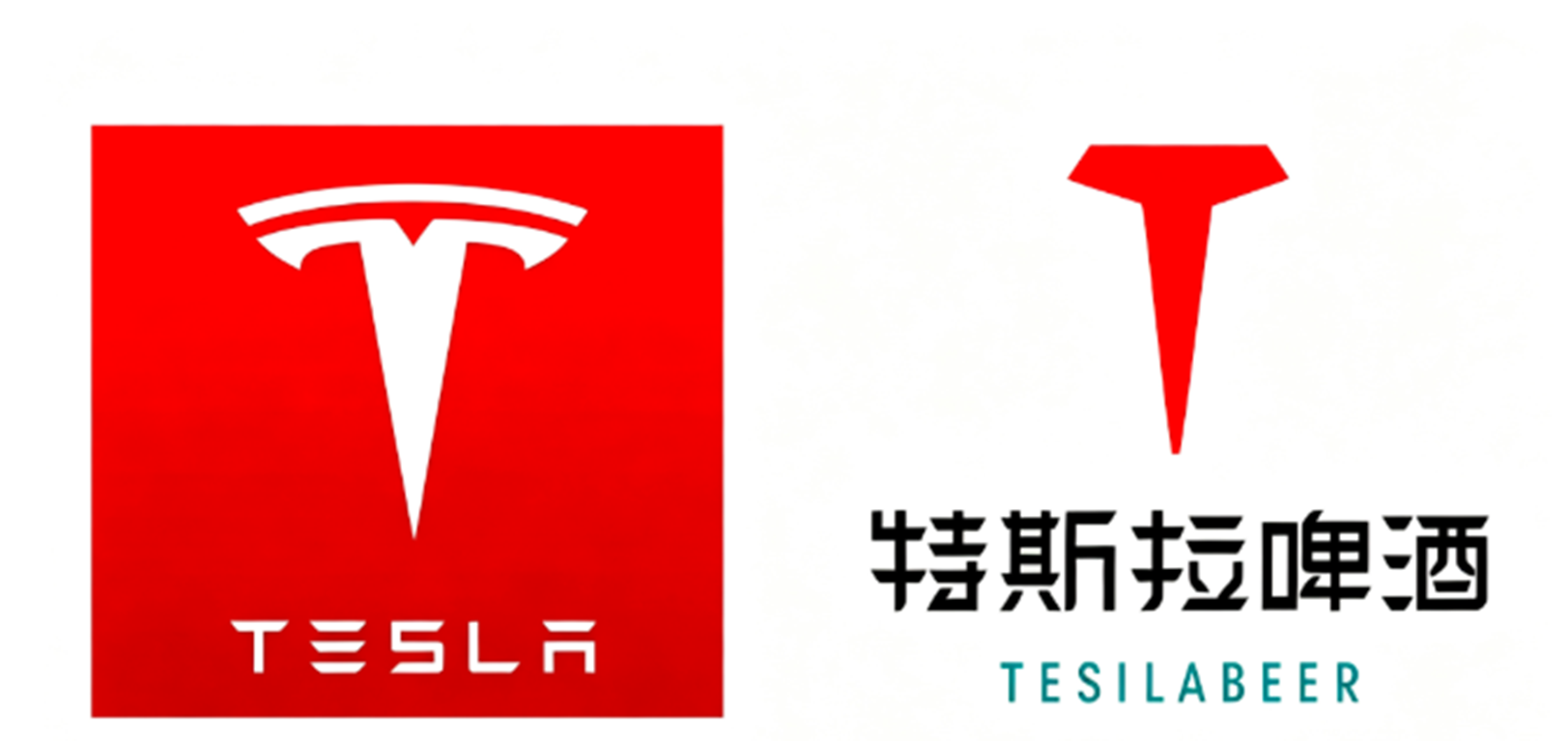
The case involved the electric vehicle brand Tesla and a Chinese beverage business that marketed alcoholic drinks using signs including “TESILA,” “TESLA,” “特斯拉” and “TESILA BEER.” The products also used a T-shaped logo resembling Tesla's trademarks. Some promotional materials went further and displayed images of Tesla vehicles.
The final result was significant: the Shanghai High People's Court upheld an award of 5 million RMB, together with orders to stop the infringement and publish a statement to eliminate its effects.
A beer called “TESILA”
The dispute began after alcoholic beverages appeared on the Chinese market under names including “Tesila Soda” and “Tesila Beer.”
At first glance, the difference between TESLA and TESILA might appear significant. There is an additional letter, and the spelling is not identical.
Trademark law, however, does not always require two signs to be exactly the same before infringement can occur.
The courts examined the signs as they were actually used in the marketplace.
According to the case materials, the disputed products used a variety of signs and combinations, including “Tesla,” “TESILA,” “特斯拉” and “特斯拉 TESILA.” The beer packaging also featured a stylized T-shaped logo that was considered highly similar to Tesla's registered marks.
Tesla Sells Cars, While the Other Party Sells Beer. So Why Could It Still Be Trademark Infringement?
This brings us to a very important concept: cross-class protection of well-known trademarks.
As a general rule, trademark rights are closely tied to the specific classes of goods and services for which a mark is registered.
Tesla’s core business is automobiles, while beer clearly falls into a completely different product category.
Article 13 of the Trademark Law of the People’s Republic of China provides that where a trademark applied for registration in respect of dissimilar or unrelated goods reproduces, imitates, or translates a well-known trademark already registered in China, and is likely to mislead the public and potentially harm the interests of the owner of the well-known trademark, registration must be refused and its use prohibited.
Put simply: The protection of a well-known trademark is not necessarily limited to the categories of goods for which it was originally registered and used.
The policy rationale is easy to understand: When a business has built a highly recognizable brand, other businesses cannot simply use that brand as a marketing tool just because they sell completely different products.
A business cannot simply argue: “You’re a car brand, and I sell beer, so there’s nothing wrong with using a trademark that looks similar to yours.”
The Shanghai courts recognized Tesla's trademarks as well-known
The Shanghai Intellectual Property Court found that six of Tesla's trademarks had acquired a very high level of recognition in China in connection with automobiles and related goods.
The court considered evidence relating to Tesla's extensive use and promotion of its trademarks, sales, reputation and other forms of protection.
The trademarks had therefore acquired the status of well-known trademarks in the relevant circumstances.
There was a broader branding pattern.
The court looked at the overall commercial impression
One of the most useful lessons from the case is that trademark disputes cannot always be reduced to a side-by-side comparison of two individual words.
The disputed products reportedly combined several elements:
signs such as TESILA, TESLA and 特斯拉;
a T-shaped graphic similar to Tesla's trademark;
combinations such as “特斯拉 TESILA”;
references suggesting an international or American premium brand; and
promotional imagery featuring Tesla vehicles.
Taken together, these elements created a strong association with Tesla.
This is an important distinction.
The case is not simply about: “TESILA shares several letters with TESLA, so it constitutes trademark infringement.”
What really matters is that the wording, graphic elements, and marketing approach collectively created a commercial impression strongly associated with Tesla, making it likely to cause consumer confusion.
The advertising made the problem worse
The use of Tesla vehicle images was particularly damaging.
Imagine a consumer encountering a beer bearing a T-shaped logo, a name resembling Tesla and an advertisement featuring a Tesla Model X.
Even if the product is beer rather than a car, the consumer might reasonably wonder whether the product is:
an official collaboration;
a licensed product;
a promotional campaign;
a Tesla-branded lifestyle product; or
otherwise commercially connected with Tesla.
Trademark law is concerned not only with whether consumers mistakenly think that two companies manufacture the same product. It can also address confusion about commercial relationships.
That is especially relevant for famous brands, which increasingly expand into merchandise, collaborations and lifestyle products.
The case also involved unfair competition
The court did not stop at trademark infringement.
It also found that the defendants' conduct constituted unfair competition, particularly because of the misleading promotional practices.
This is significant for businesses operating in China.
A company may believe that it has avoided trademark infringement because it changed a few letters in another company's name.
That strategy may still fail if the overall marketing campaign deliberately creates an association with another business.
Trademark law and unfair competition law can therefore work together.
One protects registered trademark rights. The other can address broader conduct that improperly exploits another company's commercial reputation or creates misleading associations.
Why Did the Court Award RMB 5 Million in Damages?
The courts ordered the defendants to pay Tesla 5 million RMB (around 750,000 USD), including economic losses and reasonable enforcement expenses.
The first-instance judgment also required the defendants to publish a statement in the Legal Daily to eliminate the impact of their conduct. The Shanghai High People's Court subsequently rejected the appeal and upheld the first-instance judgment. The second-instance judgment was issued on August 2, 2023.
The importance of the “TESILA” detail
The spelling issue is worth emphasizing because it illustrates an important point for international businesses.
A common misconception is that trademark infringement requires an exact copy. It does not.
The context matters.
In this case, the court was presented with more than the word “TESILA.” There were multiple related signs, a similar T-shaped logo, references to “特斯拉,” and advertising that reportedly incorporated Tesla vehicle imagery.
That broader context was critical.
A lesson for brand owners
For international companies operating in China, the case demonstrates the value of building a layered trademark portfolio.
A company should not rely exclusively on its principal word mark.
Where appropriate, protection may also be sought for:
distinctive logos;
Chinese-language versions of the brand;
transliterations;
key product names;
distinctive combinations of words and graphics; and
important marks in commercially relevant classes.
This is particularly important for famous brands that may eventually expand into new products, collaborations, licensing or merchandising.
The Tesla case shows why.
A lesson for businesses choosing new brands
The case also sends an equally important message to companies launching new products.
A business should not assume that changing one or two letters is enough to make a new trademark safe.
Before launching a brand, businesses should conduct trademark clearance not only for identical marks but also for similar marks, Chinese equivalents, transliterations and potentially confusing visual elements.
They should also consider whether their proposed advertising could create the impression of a connection with another company.
This is particularly important when the other company has a highly recognizable logo or a well-known trademark.
The broader message
The “TESILA Beer” dispute is ultimately not a story about beer versus electric cars.
It is a case about commercial association.
The Chinese courts were asked to determine whether a business selling alcoholic beverages had gone beyond legitimate brand creation and instead used signs and marketing closely associated with Tesla in a way that could mislead consumers and exploit Tesla's established reputation. The answer was yes.
The RMB 5 million award is therefore only part of the story.
The practical message for international businesses is clear:
Do not look only at whether another company has copied your exact trademark. Look at the entire branding strategy.
In a market where consumers increasingly encounter brands across multiple industries, the line between trademark infringement, unfair competition and legitimate brand creativity can be surprisingly narrow.
The Tesla case shows that Chinese courts are prepared to look beyond individual letters and examine the overall impression created in the marketplace.